

Outbuild is online scheduling software to work together on connected project schedules and look-aheads, enabling everyone to move faster.
Key Takeaways

- Schedules, Lookaheads, and Weekly Work Plans within one integrated platform.
- Real-time insights and project analytics through automated dashboards.
- Easier, streamlined plan management through a user-friendly interface.
Table of contents
- What is construction predictability?
- What drives predictability on large projects, and what kills it?
- How do data and analytics improve schedule predictability?
- How does software improve construction predictability?
- The best software platforms for construction predictability
- What role do AI and predictive analytics play?
- The data that builds predictability in construction projects
- Where to start
Finishing the project late is an accepted practice in construction.
In 2016, McKinsey reported that large projects “typically take 20% longer to finish than scheduled and are up to 80% over budget.”
That statistic should come as no surprise to anyone who’s spent time in the industry, and we’d submit that this lack of ability to meet deadlines is largely due to how we manage jobsites.
At least 70% of the 540 construction professionals surveyed in this 2020 report agree, citing jobsite coordination as the main reason their projects miss deadlines and go over budget.
The reality of construction is that there will always be delays. Weather happens. Supply chains get broken. New scope gets added.
These are all part of the job. The real issue is that we are still holding tight to practices and technology that deny these realities. This affects our ability to produce accurate schedules and, as a result, our projects miss deadlines and cost us valuable margin.
So how do we improve construction predictability? Let’s dive into it.
Construction predictability is how often work happens the way you planned it, when you planned it. A schedule communicates what you intend to do. Predictability tells you how reliably you follow through.
The two get confused constantly. Every project has a schedule. Far fewer projects can report how reliable that schedule has been over the last five weeks. That measure of reliability is what tells you how much you can trust your schedule.
Predictability is important because it influences every other metric that leadership cares about. An unpredictable project is one you cannot staff efficiently, cannot sequence trade partners against with confidence, and cannot report on without a caveat.
Ultimately, predictability isn’t a forecast, it’s a track record.
Predictability on large projects is driven by how many people have to coordinate and how honestly they report, which is why it degrades as projects get bigger. We like to blame scope and complexity, but the reality is that coordination and candor are the real variables in how predictable a project is.
More people means more variance
A big project is not a longer version of a small one. It's a larger number of people who have to agree on what happens next. Mike Wong, who has spent his career working this problem, puts it plainly: humans are the main risk to predictability.
Large projects carry office politics, frayed relationships, petty disputes, and conflicting agendas, and none of those show up as a task in the master schedule. But they do show up in delays and constraints that plague the project.
This is the part of predictability that no amount of scheduling logic can fix. You can build a technically perfect CPM schedule for a project, but it will still crumble if the team doesn’t trust each other.
How small mistakes compound
The other reality we have to deal with is that people systematically underestimate how long their own work will take. Kahneman named it the planning fallacy, and three habits keep it running:
- Optimism bias is the tendency to overestimate benefits and underestimate costs, time, and risks.
- Anchoring bias is when you rely too heavily on the first assumptions of the plan, even when new information suggests re-planning is needed.
- Illusion of control is when you are overconfident in your ability to control certain delays.
On a small job, making any of these mistakes will cost you a few days that get absorbed. On a large job, it compounds across dozens of trade partners and hundreds of commitments, and the aggregate error is too big to simply absorb.
When team members don’t trust each other, the team splinters
After food, shelter, and water, people want to belong to something. That sense of belonging is what allows teams to operate more tightly and efficiently.
On the other hand, if your people don’t feel that they have skin in the game, they will fragment into factions that compete with each other. They will focus on protecting their own position, and each one will have a different idea of what the next month should look like.
You can see this in the reporting before you see it in the schedule. When three trade partners give you three incompatible accounts of the same two-week window, you don't have a coordination problem.
You have a project crew that stopped being one team, and your forecast now has three competing versions of the future inside it.
“Data does not lie, doesn't expect a pay bump from you, does not hope you approve its vacation. Data is your only source of objective scientific truth.” - Mike Wong
Your scheduling workflow should be using data to determine the predictability of the schedule, not someone’s gut. Ideally, you’re basing this on the last five weeks of PPC reliability.
This is your measure of how much of what you said would get done, got done. We use five weeks because that’s long enough to absorb a change in weather, and enough of a sample to show you how the next five weeks will play out.
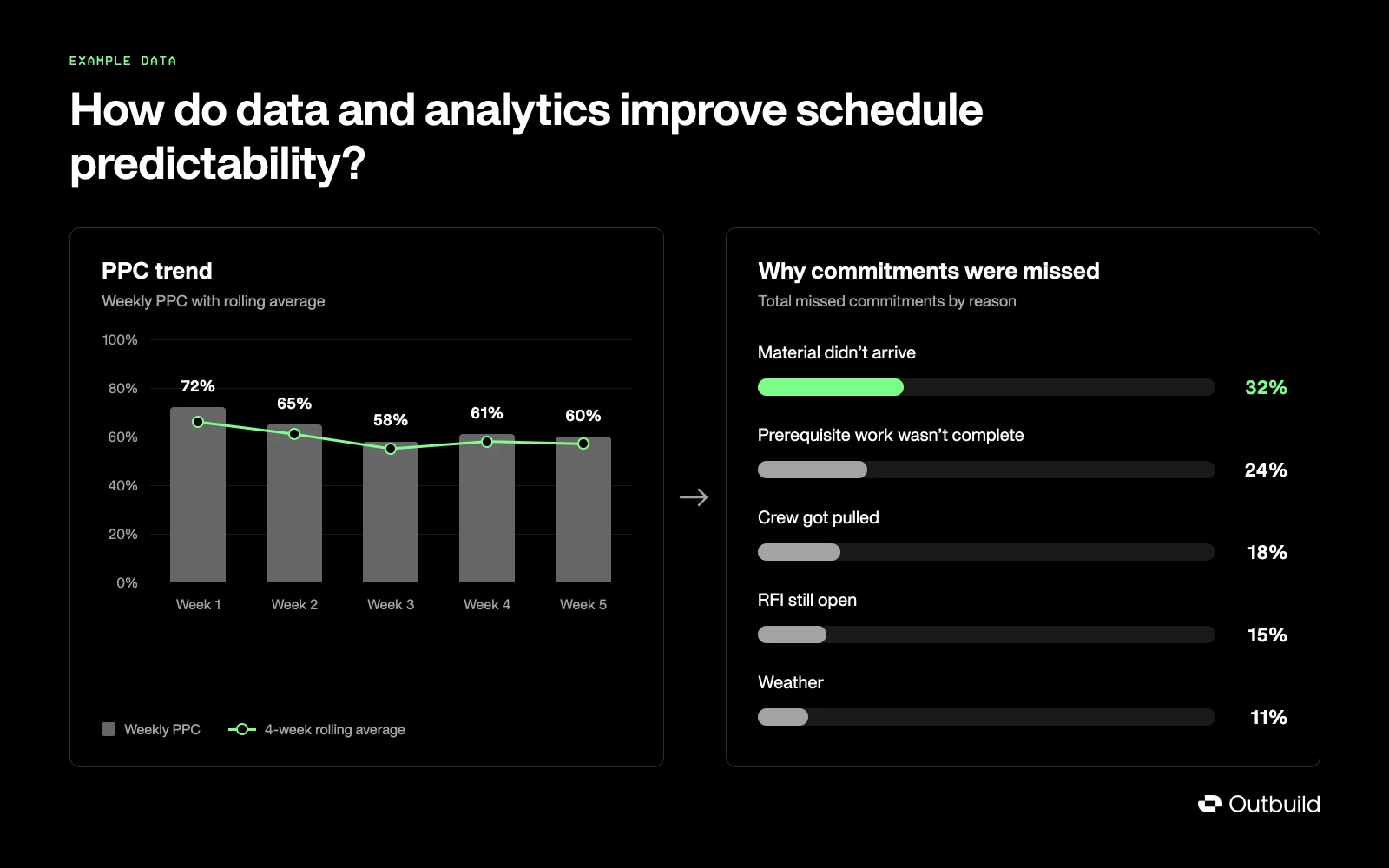
Now let’s go beyond the PPC. A PPC of 60% tells you that you have a problem, but the reasons behind it tell you which problem. Attach a reason to every missed commitment: material didn't arrive, prerequisite work wasn't complete, the crew got pulled, an RFI is still open, weather.
Now you can look back on those five weeks and have more than a list of problems, you have a pattern you can correct.Ultimately, measurement is what changes behavior. People will change their performance according to how they are measured.
Software improves construction predictability by turning commitments into a record: what was promised, by whom, for when, and whether it happened.
It can also give your team a means to collaborate and a single repository for knowledge. This gives you the best data to work with and a mechanism to record what happens.
There are three big things that the right software does for you in regards to predictability.
- The field gets access and insight into the plan. Putting the plan in front of the people doing the work is the prerequisite for everything else. It also changes the type of information you’ll receive: when a foreman can easily see the six weeks in front of him, he’s more likely to tell you about the conflict in week four while the cost is just a phone call.
- The commitment and the outcome both get captured. Most scheduling software records the plan, then records the revised plan. What it skips is what happened to change the plan. Your ability to build more predictable schedules is determined by that gap. If your system stores only the current version of the truth, there’s no track record to determine predictability.
- The system provides signals before it’s too late. Construction schedules are not static things. They have to shift as things change. The trick is that the team needs to find out about those delays as early as possible so that they can resequence the work and absorb as much of the delay as possible. The right software can help with this by connecting the field and office so you have the most current information available.
Software doesn't make people more candid, but it does remove some of your reliance on their candor. When the record shows what was committed and what happened, nobody has to volunteer bad news and nobody has to decide how much of it you can handle.
Good software lowers the cost of telling the truth instead of raising the penalty for not telling it.
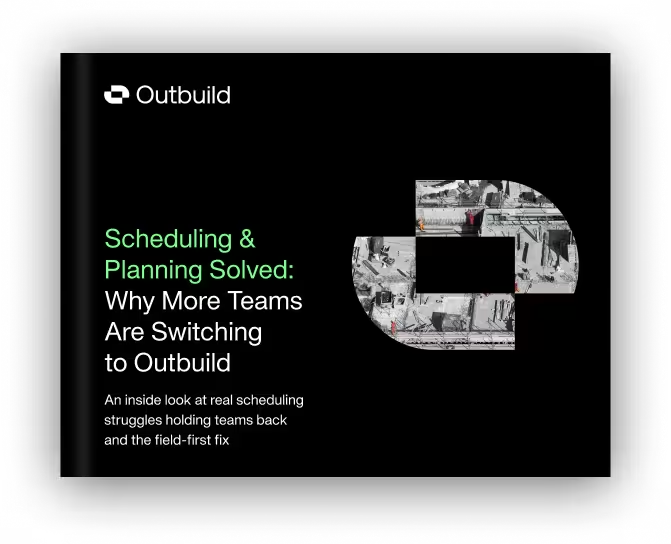
How to Fix the Disconnect Between the Office and Field.
Download the report to learn more:
- Learn about the why scheduling and planning fail the field
- Understand the pain points, inefficiencies, and evolving practices shaping scheduling today
- Find out how to bridge critical disconnects happening in construction
The best software for construction predictability is whatever tool closes the loop between the plan and the field, because the field holds all the knowledge of how to build the thing and what is standing in the way. Some of the most capable CPM engines in the industry score poorly here, not because the scheduling is weak, but because the data from the jobsite doesn’t make it back to them.
Full disclosure before the list: Outbuild makes construction scheduling software, so we have a stake in this. What follows is our honest read, including where another tool is the better fit. For a fuller evaluation of nine platforms on scheduling capability overall, see our guide to the best construction scheduling software. The list below asks one narrower question of each: does it help you measure whether you do what you said you'd do?
AI is a powerful tool that can help construction teams run even tighter schedules, but it only works when there's a reliable data layer underneath.
A model pointed at a schedule nobody updates will produce confident, fictional answers. That’s why the foundation comes first: connected scheduling, field commitments captured as they happen, reasons logged against variance. AI is what you run on top of that.
Here are three examples of how this plays out from Outbuild AI:
- It answers questions you'd otherwise have to chase down. Outbuild AI lets you ask about your schedule in plain language and get answers grounded in your actual project data, not in general construction knowledge.
"Which activities slipped more than five days this month, and why?" is a question that used to take a scheduler an afternoon to answer. But now you can get the answer in a few minutes.
- It catches what a manual review misses. Schedule health checks run against the logic of a schedule and flag the problems that can easily slip by: open ends, negative float, constraints doing work that logic should be doing.
"The Schedule Health Agent alone justifies the tool. I ran it against several schedules and it flagged issues in seconds that would have slipped past a manual review. Every check comes back pass, warning, or fail, with the specific activities called out visually, making it trivial to chase down common issues that can derail proper scheduling discipline. It's work that used to take hours, if it even got done." - Greg Cashen, VP Operations, Catamount Constructors
- It finds patterns across projects that are simply too broad for us to hold in our heads. A trade partner whose PPC drops in the third month of every job is a pattern invisible on any single project and obvious across twelve.
What AI can’t do is make predictions from data you never collected. It can't tell you your commitment reliability if nobody recorded the commitments, and it can't tell you why work slipped if nobody logged a reason.
Every AI capability in this category is downstream of the measurement discipline we covered earlier. Build the foundation first, and then the intelligence on top of it will be worth something.
If you want to improve construction predictability, you have to start with tracking the data so you can inform future schedules and improve your performance. Below are the metrics you should start with.
For the weekly mechanics of running this, our guide to schedule risk control without a specialized scheduler walks through the review itself, step by step.
Improving construction predictability starts with measuring one thing: how much of the work that was committed to last week got done? Then, make sure every delay has a reason attached and you’ll have all the data you need to start improving the number.
Finishing late is an accepted practice in construction partly because, for most of the industry's history, nobody proved it was avoidable. The data to prove otherwise now exists on every project. It just has to be captured, and somebody has to act on it.
See how Outbuild connects your master schedule to what actually happens in the field. Get a personalized demo.
How to Fix the Disconnect Between the Office and Field.
The best software for construction predictability is whatever tool closes the loop between the plan and the field, because the field holds all the knowledge of how to build the thing and what is standing in the way. Some of the most capable CPM engines in the industry score poorly here, not because the scheduling is weak, but because the data from the jobsite doesn’t make it back to them.
Full disclosure before the list: Outbuild makes construction scheduling software, so we have a stake in this. What follows is our honest read, including where another tool is the better fit. For a fuller evaluation of nine platforms on scheduling capability overall, see our guide to the best construction scheduling software. The list below asks one narrower question of each: does it help you measure whether you do what you said you'd do?
AI is a powerful tool that can help construction teams run even tighter schedules, but it only works when there's a reliable data layer underneath.
A model pointed at a schedule nobody updates will produce confident, fictional answers. That’s why the foundation comes first: connected scheduling, field commitments captured as they happen, reasons logged against variance. AI is what you run on top of that.
Here are three examples of how this plays out from Outbuild AI:
- It answers questions you'd otherwise have to chase down. Outbuild AI lets you ask about your schedule in plain language and get answers grounded in your actual project data, not in general construction knowledge.
"Which activities slipped more than five days this month, and why?" is a question that used to take a scheduler an afternoon to answer. But now you can get the answer in a few minutes.
- It catches what a manual review misses. Schedule health checks run against the logic of a schedule and flag the problems that can easily slip by: open ends, negative float, constraints doing work that logic should be doing.
"The Schedule Health Agent alone justifies the tool. I ran it against several schedules and it flagged issues in seconds that would have slipped past a manual review. Every check comes back pass, warning, or fail, with the specific activities called out visually, making it trivial to chase down common issues that can derail proper scheduling discipline. It's work that used to take hours, if it even got done." - Greg Cashen, VP Operations, Catamount Constructors
- It finds patterns across projects that are simply too broad for us to hold in our heads. A trade partner whose PPC drops in the third month of every job is a pattern invisible on any single project and obvious across twelve.
What AI can’t do is make predictions from data you never collected. It can't tell you your commitment reliability if nobody recorded the commitments, and it can't tell you why work slipped if nobody logged a reason.
Every AI capability in this category is downstream of the measurement discipline we covered earlier. Build the foundation first, and then the intelligence on top of it will be worth something.
If you want to improve construction predictability, you have to start with tracking the data so you can inform future schedules and improve your performance. Below are the metrics you should start with.
For the weekly mechanics of running this, our guide to schedule risk control without a specialized scheduler walks through the review itself, step by step.
Improving construction predictability starts with measuring one thing: how much of the work that was committed to last week got done? Then, make sure every delay has a reason attached and you’ll have all the data you need to start improving the number.
Finishing late is an accepted practice in construction partly because, for most of the industry's history, nobody proved it was avoidable. The data to prove otherwise now exists on every project. It just has to be captured, and somebody has to act on it.
See how Outbuild connects your master schedule to what actually happens in the field. Get a personalized demo.
Frequently Asked Questions
Software improves construction project predictability when it captures both the commitment and the outcome in the same system as the schedule. Most standalone CPM tools record the plan and then the revised plan, which leaves no record of what was promised in between, so they produce no reliability data at all. Platforms that connect the master schedule to the field, like Outbuild, generate commitment reliability as a by-product of normal use. Primavera P6 and Asta Powerproject have a lot of scheduling capability but need a separate system to collect what happens on site.
You improve predictability in construction scheduling by measuring commitment reliability and acting on the reasons attached to delays. In practice that means five steps: get the lookahead in front of the field, have teams commit to a weekly work plan, record what got done, attach a reason to everything that didn't, and review the rolling five-week average. Most of the improvement comes from the reasons rather than the score, because the reasons tell you whether you have a sequencing problem, a procurement problem, or a manpower problem.
AI can analyze recorded project data to answer schedule questions, flag logic issues, and identify patterns across projects. Its findings depend on reliable data. If teams do not record commitments, outcomes, and reasons for variance, AI cannot provide a dependable view of predictability.
The most common reasons for variance are materials that didn’t arrive on time, prerequisite work that wasn’t finished, crews reassigned to other work, open RFIs or missing design information, and weather. Behind many of these is the planning fallacy: teams consistently underestimate how long their own work will take, through optimism bias, anchoring on the original plan, and overconfidence about controlling delays. Logging a reason against every missed commitment turns these causes into patterns you can correct, such as a recurring procurement gap or a trade partner who overcommits.
Outbuild connects the master schedule, the lookahead, and the Weekly Work Plan in one system. Field commitments and their outcomes are recorded in the same place as the schedule, so PPC and reasons for variance are produced as a by-product of normal use instead of being collected separately. Roadblocks flag constraints before they stall work, and Schedule Impact Requests send field issues to the scheduler for a decision, so problems reach the office early. On top of that data layer, Outbuild AI answers schedule questions in plain language, and the Schedule Health Agent flags logic issues such as open ends and negative float in seconds.
Related Articles


Ready to see Outbuild?
Join hundreds of contractors from 10+ countries that are saving money by scheduling better



We’ll be in touch soon!